
EMF Shielding vs Grounding: Do You Need Both in Your Bedroom?
Grounding and EMF shielding appear in the same conversations about sleep, but they are two different practices with two different jobs. One connects your body to the earth. The other places a conductive barrier between your bed and the electromagnetic fields around it. Confusing them leads to bad purchases and disappointing results, so it is worth separating them clearly before you spend anything.
What grounding does
Grounding, also called earthing, puts your skin in contact with a conductive surface that is connected to the earth. In practice that surface is usually a grounding sheet on the mattress, a mat on the floor, or a pillowcase under your head. YONWOLD bedding uses a silver fiber blend, with 10% silver fiber knitted into the fabric so that conductivity is spread across the whole panel rather than concentrated in a few threads. A snap connector, a grounding cord, and the ground pin of a wall outlet complete the path.
The purpose is contact. If your skin is not touching the conductive side, nothing happens. That is why fit matters more than marketing: a sheet that pulls loose at the corners, or a mat that slides off the bed, breaks contact for the whole night.
What EMF shielding does
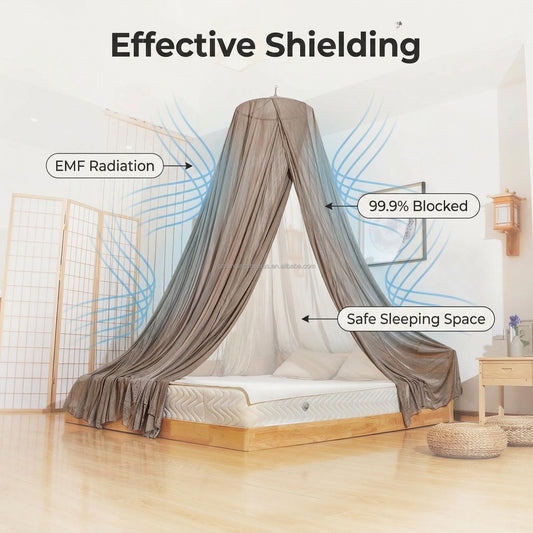
Shielding works on the environment instead of on you. A conductive textile placed between your body and a source of radio-frequency fields, such as a wifi router on the nightstand, a smart meter on the shared wall, or a mobile mast in direct line of sight, reduces the field strength that reaches the bed. The 100% Silver Fiber EMF Canopy with Grounding Cord is built as a bed-sized enclosure for exactly this job: silver fiber fabric over a frame, with a cord that ties the fabric itself to ground.
Two properties decide whether a shield performs: coverage and continuity. A blanket thrown over the duvet leaves the head of the bed exposed. A canopy that is open on one full side is a compromise, not a sealed room. And any conductive fabric that is not connected to ground can hold a small charge of its own, which is why the grounding cord is part of the product rather than an optional extra.
Where the two overlap
The meeting point is the ground connection. A shield needs a path to earth to behave predictably, and a grounding setup needs a conductive surface that stays in contact. That is also why the grounding cord with adapter splitter is useful in a shared setup: one grounded outlet can serve a sheet and a canopy at the same time without daisy-chaining random cables.
How to choose
Start from the problem, not from the product.
- You want a conductive sleep surface. A grounding sheet, fitted sheet or sleeping mat is the direct route. The Grounding Fitted Bed Sheet stays tucked around the mattress, which keeps contact stable through the night.
- You are concerned about field exposure in the bedroom. Shielding addresses that variable. Move the router first, because distance costs nothing, then consider a canopy if the source is outside your control.
- You want both. Run each item on its own cord, or use a splitter with a verified ground. Do not assume that two conductive items touching each other are both grounded.
A bedroom setup that works
- Check the outlet. Use a socket tester and confirm that the ground pin is actually connected. A two-wire circuit will not ground anything.
- Fit the sheet. Pull it tight enough that it does not wrinkle away from the mattress, and keep the snap connector at a corner you will not kick.
- Add the pillowcase. The grounding pillowcase in 10% silver fiber covers the hours when your face is in contact with the bed.
- Hang the canopy. Keep the fabric between the bed and the wall or window that faces the source, and leave enough slack that the cord is never under tension.
- Test before you sleep on it. A continuity tester or a grounding tester pen will show whether the surface is actually connected. Five minutes of testing saves weeks of guessing.
What the research does and does not show
Grounding research is small and mostly short in duration. Published studies report changes in self-reported sleep quality, relaxation and some markers of inflammation, but sample sizes are limited and protocols vary between studies. It is reasonable to describe grounding as something that may support a calmer bedtime routine. It is not a treatment for insomnia, pain or any medical condition, and it does not replace care from a clinician.
On the shielding side, the physics of conductive fabric is well established, while the health debate around everyday field levels is not settled. Public exposure limits from health agencies are set with large safety margins, and shielding is best treated as a way to reduce exposure you cannot otherwise avoid, not as a medical intervention.
Common mistakes
- Buying a conductive sheet but sleeping on the wrong side, or under a thick mattress pad.
- Assuming a grounded appliance nearby also grounds the bed. It does not.
- Using an ungrounded canopy and expecting it to behave like a grounded one.
- Never testing. Conductivity fades with washing, wear and damaged cords.
- Treating either practice as a substitute for the basics: a dark room, a cool temperature and a consistent schedule.
Shop the products
- 100% Silver Fiber EMF Canopy with Grounding Cord
- Grounding Sheet 10% Silver Organic
- Grounding pillowcase 10% silver fiber
- Grounding Cord with Adapter Splitter
If you are unsure which combination fits your bedroom, start with the surface you touch most, and add the rest once you have confirmed that the ground connection in your home is real. This article is general information, not medical advice. Speak with your doctor before changing how you manage sleep or any health concern, particularly if you use an implanted electronic device.