
EMF Canopy and Grounding Sheets: How to Build an EMF-Aware Bedroom
You spend roughly a third of your life in bed, which is why the bedroom is usually the first room people think about when they want to lower EMF exposure and add earthing to a daily routine. Two different product families often get mixed together in that conversation: grounding sheets and mats, which give your body a conductive path to the earth, and an EMF canopy, which uses conductive silver fiber fabric to shield the bed from ambient radio-frequency energy.
They are not competitors. In most bedrooms they are used together, and the setup is simpler than it sounds. This guide covers the order that works best: bed surface first, shield layer second, grounding path third, then verification. It also covers the details that decide whether a setup actually does anything, from the outlet you plug into to the layers between your skin and the fabric.
Grounding and shielding do two different jobs
Grounding, often called earthing, is about your body. A grounding sheet or mat is built with conductive fiber and connected by a cord to a grounded wall outlet or an outdoor grounding rod, so the surface you rest on is in contact with the earth.
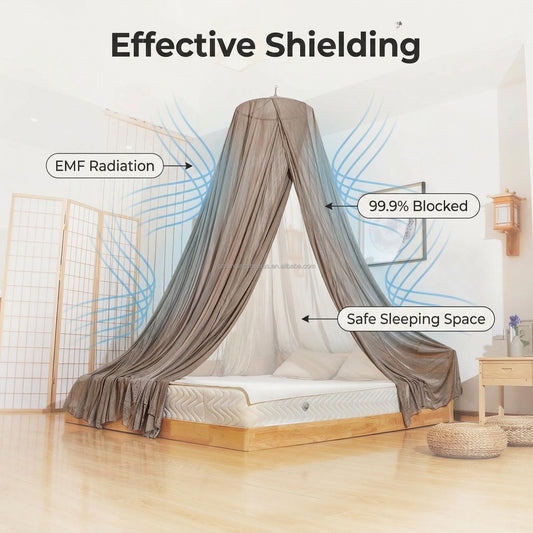
Shielding is about the space around you. An EMF canopy is made from 100% silver fiber fabric and is designed to attenuate radio-frequency fields, so the field strength inside the canopy is lower than in the open room. If you want the longer explanation of how the two ideas relate, we compared them in grounding vs EMF protection.
Because the jobs are different, the products are different, and you can start with either one. The order below simply matches how most bedrooms get built.
Step 1: Get the bed surface right
The sheet is the part your body touches, so it does the actual grounding work. Two formats cover almost every bed.
- Grounding Fitted Bed Sheet: elasticated at the corners so it stays flat on the mattress and behaves like an ordinary fitted sheet. Best when you want the grounding layer to be the sheet you actually sleep on.
- Grounding Sheet 10% Silver Organic: a flat sheet you lay over the mattress or over your existing sheet. Best when you want to keep your current bedding and add a grounding layer to it.
YONWOLD sleep surfaces are built around a silver fiber blend, and the product names describe that blend directly: the sheets use 10% silver fiber, while the canopy uses 100% silver fiber fabric. Silver is used because it is highly conductive, which is what allows the fabric to carry charge instead of insulating it.
Two practical notes. Direct skin contact works best, so thin sleepwear, or simply a bare arm or leg resting on the fabric, is enough. And the sheet only works while the cord is connected and the outlet it runs to is genuinely grounded, which is step 3.
Step 2: Add the canopy as the shield layer
Once the bed surface is set, the next layer is the one that surrounds it. The 100% Silver Fiber EMF Canopy with Grounding Cord is a silver fiber canopy that hangs over the bed and connects to the same kind of grounding path as your sheet.
Setting it up is mostly about geometry, not force:
- Hang the canopy so it drapes around the bed rather than lying only across the top. Coverage of the sides and the head end is what separates a canopy from a simple blanket.
- Keep an opening where you get in and out. A canopy does not need to be sealed to be useful in a bedroom.
- Connect the grounding cord and leave it connected. An ungrounded canopy is just fabric.
Step 3: Build one clean grounding path
This is the step people rush, and it is the one that decides whether anything works. A grounding sheet and a grounding canopy both need a path to earth, and most bedrooms have only one convenient outlet beside the bed. That is exactly what the Grounding Cord with Adapter Splitter is for: it lets two grounded items share a single outlet through one adapter.
Before you plug anything in, check the outlet. Not every socket is grounded, and an outlet that is not grounded cannot ground your sheet. A plug-in outlet tester from any hardware store will tell you in seconds. Older homes, travel adapters, extension leads and unearthed sockets are the usual culprits.
Step 4: If the outlet is not a reliable ground
If the socket beside your bed is not grounded, you do not have to abandon the setup. The Grounding Rod creates a direct earth connection outdoors and is the standard solution for rooms without a reliable ground, which is why we wrote a separate guide to grounding with a rod. If you use one, keep the cord run tidy and out of the way, and disconnect the outdoor connection during storms.
Step 5: Cover the rest of the room
Bedrooms are not only for sleeping. If you work, read or watch television in the same room, a Grounding Mat under your feet or on your chair gives you the same conductive contact while you are awake, without changing your bedding. It uses the same cord and outlet, so it slots into the setup you have already built.
How to check that your setup is really connected
Two checks solve almost every problem.
- Test the outlet with a plug-in tester. This confirms the socket itself is grounded.
- Check the connection points. The snap connector on the sheet and the plug on the cord are the two places that usually fail, normally because the snap is not fully seated or the cord has been damaged.
If you want a direct reading, a multimeter or continuity tester can be used to confirm continuity between the sheet fabric and the ground pin of the cord. If you are not comfortable doing that, have an electrician confirm your bedroom circuit instead.
What an EMF-aware bedroom is not
An EMF-aware bedroom is a reduction strategy, not a sealed room. A canopy lowers field strength inside it and a grounding sheet gives you conductive contact with the earth, but neither is a medical treatment. Grounding and EMF products are consumer wellness products, not medical devices. If you have a health condition, are pregnant, or use an implanted electronic device such as a pacemaker, speak with your doctor before adding earthing or shielding products to your routine.
Set expectations the way you would with any sleep or environment change: keep the setup simple, keep it connected, and give it a few weeks before judging it.