
Grounding FAQ: 10 Common Earthing Questions, Answered
If you have been reading about earthing and grounding products, you have probably run into the same handful of questions. Does a grounding sheet really connect you to the earth? Do you have to sleep on bare skin? What happens if your outlets are not grounded? This guide answers the questions we hear most often from customers, in plain language — including where the evidence is still developing, and where the honest answer is simply to try it and see how you feel.
1. What does "grounding" — or "earthing" — actually mean?
Grounding means putting your body in contact with a surface that sits at the earth's electrical potential, which is close to zero. Standing barefoot on grass, sand, or wet stone is the original version. Indoor grounding products — a Grounding Sheet 10% Silver Organic, a mat, or a pillowcase — do the same job through a conductive fabric connected by a cord to the ground pin of a wall outlet, or to a rod driven into the soil outside.
That conductive path is the entire mechanism. There is nothing to "activate," no power is drawn from the outlet, and no electricity is sent into your body. The cord simply gives your skin a low-resistance route to the same reference point the earth provides.
2. How do grounding sheets, mats, and pillowcases differ?
The difference is contact time and body area, not technology.
- Grounding sheets cover the largest area and stay in contact with you for the longest stretch — typically a full night. A fitted version such as the Grounding Sheet Fitted Organic 10% Silver stays stretched over the mattress, while a flat sheet is easier to move between beds or take travelling.
- Grounding mats are built for shorter, seated sessions: under a desk, in front of the television, or on the floor during a stretch. The Grounding Mat and the Grounding Mat Sleeping sit in this category.
- Grounding pillowcases keep the conductive surface against your face, neck, and shoulders, which helps if you move a lot in your sleep or share a bed. The Grounding pillowcase 10% silver fiber is the lightest way to start.
3. What is silver fiber, and why does the percentage matter?
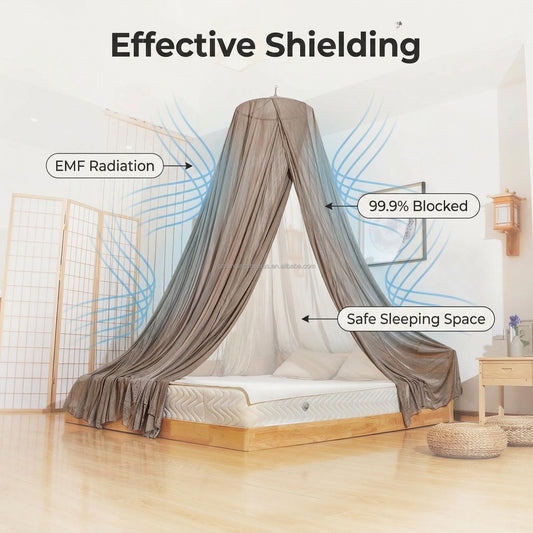
Silver is one of the most conductive metals available for textiles, and it can be woven into a fabric without making it stiff or scratchy. The silver in the weave is what carries the charge from your skin to the cord. A fabric with a higher silver content generally holds its conductivity better through repeated washing, which is why a 10% silver fiber construction is a common benchmark for bedding — and why the 100% Silver Fiber EMF Canopy with Grounding Cord uses a denser silver weave for a different purpose.
Two practical consequences: check the stated silver content before you buy, and treat conductivity as a property that can fade if the fabric is abused.
4. Do I need bare skin contact?
For the connection to work, the conductive surface has to touch your skin. A layer of ordinary cotton between you and the sheet reduces or blocks it entirely. Most people find a fitted grounding sheet comfortable against bare legs and arms under a regular duvet, and a pillowcase is naturally in direct contact with your face. If you prefer long sleeves, a mat under your forearms and hands is an easier place to start.
5. How long before I notice anything?
Some people report falling asleep faster or waking less often within the first week; others notice nothing at all. There is no schedule that applies to everyone, and it is worth being sceptical of the more dramatic claims you see online. Earthing is not a treatment for a medical condition, and individual responses vary widely. It is reasonable to give any new routine a few weeks before you judge it.
6. What if my outlets are not grounded, or I live outside the US?
If your home's wiring includes a working ground, a standard cord and plug will do the job. If you are unsure, an inexpensive outlet tester will tell you in seconds.
Two situations need a different solution:
- Ungrounded or older wiring: use an outdoor Grounding Rod, which connects your product to the soil directly instead of relying on your home's electrical system.
- Travelling or a different plug standard: the Grounding Cord with Adapter Splitter ships with multiple international adapters, so the same sheet or mat can be used in another country.
7. How do I check that my grounding product is actually working?
You do not need special equipment. A basic continuity tester — or a multimeter set to resistance — placed between the conductive fabric and the ground pin of your cord will show whether the path is intact. If the reading changes when the cord is connected, the connection is fine. If nothing changes at all, reseat the snap connector, then check the outlet or the rod.
8. Can I wash a grounding sheet, mat, or pillowcase?
Yes, gently. Follow the care label that came with your product. As a general rule, cooler water, a mild detergent, and air drying are kinder to silver-based textiles than hot water and a hot tumble dryer, and they help the fabric keep its conductivity for longer. Skip fabric softener, which leaves a coating on the fibers.
9. Is grounding safe?
For most healthy adults, using a grounded sheet, mat, or pillowcase is a low-risk addition to a bedtime routine. That said, it is not a medical device, and it is not a substitute for diagnosis or treatment. If you are pregnant, use a pacemaker or another implanted electronic device, have a heart condition, or take prescription medication, talk to your doctor before you start.
One more safety point: never modify a grounding cord to fit an outlet, never remove the ground pin, and never connect a grounding product to anything other than a proper ground.
10. Which product should I start with?
If you want the longest contact time and the largest contact area, start with a sheet. If you are curious but hesitant, a pillowcase is the least intrusive entry point. If you spend your days at a desk, a mat gives you hours of contact without changing your sleep setup at all. For colder months, the yonwold Grounding flannel Blanket adds a grounded layer you can keep on the sofa.
The bottom line
Grounding is a simple idea: give your skin a conductive path to the earth, and leave it there. The questions above are the ones that decide whether it fits your life — silver content, bare-skin contact, a real ground connection, and a routine you will actually keep.
This article is for general information only and is not medical advice. Grounding products are not intended to diagnose, treat, cure, or prevent any disease. Please consult your doctor before changing your health routine.