
How Long Should You Ground Each Day? Duration, Timing and What to Expect
Ask ten people who use earthing products how long they ground each day and you will get ten different answers. Some sleep on a grounding sheet every night. Some keep a grounding mat under their desk for a couple of hours. Others sit on a mat for twenty minutes in the evening and call it done.
The honest answer is that there is no single official dose. What there is, instead, is a set of practical guidelines that make it easier to build a routine you will actually keep. This guide walks through how long to ground, when to do it, and what to realistically expect along the way.
The short answer: start with 30 minutes and build from there
If you are new to earthing, most people find it easiest to begin with a short daily session and let the habit form before extending it. Thirty minutes is a common starting point. It is long enough to register as part of your routine, and short enough that it does not compete with the rest of your day.
From there you can extend in steps: thirty minutes, then an hour, then an afternoon at your desk. The point of building gradually is comfort and consistency. There is no built-in threshold you have to reach on someone else's schedule.
Overnight grounding: the six-to-eight hour option
For most people, the simplest way to accumulate time is to stop scheduling it altogether and let it happen while they sleep. A grounding sheet or a grounding sleeping mat stays in contact with your skin for six to eight hours without you having to remember anything.
If you go this route, choose a product that matches how you sleep. A fitted Grounding Sheet 10% Silver Organic covers the whole mattress and suits people who move around at night, while a Grounding Mat Sleeping is a good fit for anyone who prefers a mat laid on top of existing bedding. If you would rather keep the change small, a Grounding pillowcase 10% silver fiber adds contact at the head of the bed without touching the rest of your setup.
Daytime sessions: 20 to 60 minutes is plenty
Not everyone wants to sleep on a grounding product, and some people simply prefer a shorter, more deliberate session. Twenty to sixty minutes is a comfortable range for daytime use.
The easiest way to reach it is to attach the session to something you already do. A Grounding Mat under your laptop, keyboard or dining chair turns desk work, reading or watching television into grounded time without adding a single item to your schedule. Place it under bare forearms or bare feet rather than through shoes or thick socks.
Timing: morning, after a workout, or before bed
When you ground is mostly a question of what fits your day, but a few patterns come up again and again:
- Before bed. A twenty to thirty minute session on a mat or pillowcase while you read or wind down is a common way to close the day.
- While you sleep. The longest and least effortful option, if you are comfortable on a sheet, sleeping mat or pillowcase.
- After exercise. A mat session after training slots naturally into a cooldown routine.
- During work. Desk time is dead time that can double as grounded time.
What you may notice, and what research can say
Earthing is a comfort and lifestyle practice, and the research around it is still early and limited. People describe a wide range of experiences, from feeling more settled in the evening to simply enjoying the routine itself. Individual experiences vary, and no earthing product should be described as treating, curing or preventing any medical condition.
It is worth setting expectations for the opposite case too. Many people notice no dramatic difference at all, and that is not evidence that their product is faulty. If you want to confirm that your setup is genuinely connected, the useful check is a conductivity test on the product itself rather than a feeling.
Is it possible to ground for too long?
There is no established maximum, and long overnight sessions are common practice rather than an exception. That said, more is not automatically better. If a long session leaves you feeling restless, chilly or simply uncomfortable, shorten it. Comfort is the variable that decides whether a routine survives, and a routine that survives is the only one that matters.
A few practical notes for longer sessions:
- Temperature. A yonwold Grounding flannel Blanket keeps a night-long session comfortable in a cool room.
- Skin contact. Conductive products need to touch skin. Thin cotton is generally fine; thick layers and heavy synthetic bedding interrupt contact.
- Placement. For sleep, put the conductive side where your body rests. On a pillowcase, the side of your face and neck is what counts.
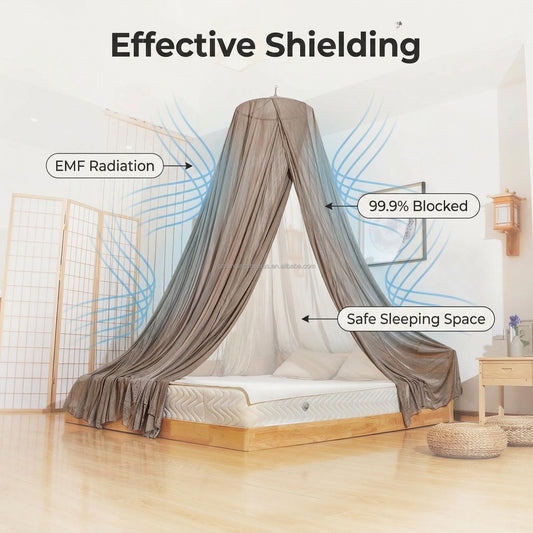
- Sleep environment. If you also want to address radio-frequency exposure overnight, the 100% Silver Fiber EMF Canopy with Grounding Cord is a silver fiber canopy that ships with its own grounding cord.
A simple first week
If you would rather follow a plan than guess, this sequence is a reasonable starting point:
- Days 1 to 3: twenty to thirty minutes a day on a grounding mat, ideally at the same time each day.
- Days 4 to 5: extend to forty-five minutes, or add a grounding pillowcase to your wind-down routine.
- Days 6 to 7: if the routine still feels comfortable, add overnight use with a grounding sheet, sleeping mat or pillowcase.
Keep the rest of your evening routine intact. The goal is to add contact with the earth, not to rebuild your entire night.
Who should ask their doctor first
If you have a health condition, an implanted medical device such as a pacemaker, or you take medication, talk with your doctor before adding earthing to your routine. Earthing is not a substitute for medical care.
For everyone else the practical rule is simple: pick a duration you can repeat, use the product consistently, and adjust based on comfort rather than on a target number.